Listening to Hope’s Whisper

Shame shouts, “Things will never change. Why even try?”

Shame corrodes the very part of us that believes we are capable of change. (Brene Brown)

Shame reminds us every of mistake, every failed attempt, and mocks the idea that we could change.

Hope whispers gently, “Things don’t have to stay the same.”

Hope begins as the first light of dawn, signaling the end of the darkness. Its glow is small at first, but grows brighter and brighter.

Fighting for hope means kicking shame to the curb and moving toward change – one step at a time.


Fighting for Hope When Things Don’t Make Sense

When the kids were little they would often say, “Mama, tell me a story!”

I would begin, “Once upon a time there were three little pigs. One built his house out of LEGOs, one built his house out of candy…”

“That’s not the way the story goes!” The kids would giggle. Or, if they weren’t in silly moods, they would cross their arms and grouch. “No! Tell it right.”

It was fun to mix up the stories. But these day I feel like I am in a story that isn’t going the way I think it should.

As I look through the Bible, I see that I’m not alone. God has always had a way of doing unexpected things. He often chose the smallest, the weakest, the most unusual way.

He promised Abraham that he would be the father of a great nation when Abraham and Sarah were too old to even have children. And then had them wait for years before Isaac was born.

He put David, the young shepherd boy, against the giant Goliath holding only a sling and a few stones.

I love reading these accounts in the Bible.  I love the way God shows His power through these situations. But living out these types of stories in the year 2017 is another matter altogether. When the events are happening In real time it’s harder to trace the hand of God through the shadowy twists and turns.

In the midst of these shadows my heart whispers, “This isn’t the way the story goes, is it, God?”

And in the midst of my confusion, even as I’m questioning God, I am looking in the right direction.

When I don’t understand what God is doing,  I can lean toward Him and ask. And I have. In the dark of night, in the light of day, I have asked question after question.

I’m sure you have, too.

I fully believe God can handle our asking, our ranting, our anger. I’ve found that when I seek Him, He answers gently, not through direct answers to my questions, but in revealing more about Himself.

These times make me ask Do I really know  God? Do I know Him for who He says He is or do I know the version I’ve made up?

Because in these confusing times, the version we make up isn’t going to stand. These confusing times cause us to question God, to really look at Him, maybe for the first time.

He knows we don’t really need because statements to match our whys. We need Him.

Knowing God leads to trust. The more we know Him, and the more we know His tender love for us, the more we can trust His Hand in our lives.

And as I fix my gaze on who He is and who I am to Him, I find that I can trust Him with the unknown.  I find that I can say, “I don’t know why this is happening, but I do know You. And I will trust what You are doing.” I can cling to his promise of His steadfast love and plentiful redemption.

Because at the heart of God, is this:

For in Him all the fullness of God was pleased to dwell, and through him to reconcile to himself all things, whether on earth or in heaven, making peace by the blood of his cross. (Colossians 1:19-20, ESV)

At the heart of God, the driving force behind His actions is to reconcile, to restore.  To bring His people before His face. He works in and through the brokenness of this world to bring about wholeness in Him. Through the grief, through the tragedy, we can track His heart.

What does this matter? How does it connect with fighting for hope?

My measure of God is the measure of my hope. If I believe God is small, powerless, unable to save – my hope will be, at best, based on my current mood.

But if I see His majesty and power, in Scripture and in my life, my hope will be an anchor that keeps me steady in spite of mood or circumstance.

Hope that anchors reminds us of His promises. Hope that anchors reminds us of His character. Hope that anchors reminds us who we are to Him. This hope gives us strength to continue fighting, even when things don’t make sense.


Finding Hope When Fear Rages

jbo8vdcy4mo-dmitriy-me2dev

Fear is running rampant, unchecked and wild, through our world. The events unfolding before us is a large-scale picture of what has been going on in our homes and in our hearts since (almost) the beginning of time. Fear is a one-size-fits-all epidemic. It uses the same methods when it rears up in my heart, in my marriage, and in my friendships as when it runs through a crowd or a nation.

Fear isolates. It whispers in the darkness “You are alone. No one will help you.” It covers us with shame to keep us bound in addictions. It makes us think no other marriage has struggled like ours, no other person has had dark thoughts like these. It whispers lies to keep us from coming into the light.

Fear encourages us to see others in an all-or-nothing sense. It paints people with a wide brush so that it can make them objects and not real people. It divides people into groups and creates division and anger with statements like

All __________ are ____________. (You fill in the blank)

Statements like these create further division because no one likes to be painted with a wide brush. Fear makes us forget that people are individuals, created by God and therefore worthy of respect. We forget that these individuals have independent thoughts, beliefs, and feelings.

Fear takes away curiosity. Fear makes us so ready to defend ourselves at all cost that it takes away our ability to ask questions that will help us understand someone else’s point of view.

Fear begets fear. The more we surround ourselves with fearful thoughts, statements, and actions, the more fear will surround out hearts and paralyze us.

Fear chokes out hope. Fear screams and calls for immediate, desperate action. Fear makes us think we are alone, without help, and ultimately without hope. Fear paints the future in total darkness.

Fear is like a tornado. It is loud and destructive and throws debris on everyone around. As long as the tornado is there, no one can reach out to help, no one can be heard over the noise, and everyone gets hurt.

Hope is something else entirely. Hope starts out quiet, sometimes as a small spark. The presence of hope can remove the fear tornado so that healing can take place.

Hope builds community. When we surround ourselves with people who fight for hope, we hear these beautiful words, “You are not alone. I am with you.” They remind us of truth, which brings us into the light. And Hope Warriors lovingly help us let go of the lies we’ve believed for far too long.

A photo by Steven Wei. unsplash.com/photos/g-AklIvI1aI

Hope makes us curious. It makes us question the way things are. We ask “What if…” “Does it have to stay this way?” “What would it look like if…” or “What am I hoping for?”

As we see each other as individual humans, and ask the curious questions in order to understand different views, we get to know each other. And we will find that what we have in common, the search for love, security, acceptance, and worth, is important.

Hope begets courage. Hope stirs a quiet, fierce strength inside us. Hope helps us believe the future could be good. When those around us are pointing us toward truth, we grow brave. When we point others toward truth, we grow strong.

Hope reminds us that change is possible. It reminds us that the last chapter has not been written, and that we hold the pen to begin a new chapter.

When we fight for hope and live brave, so much is possible.


When There Is No Script: Recap

IMG_4702
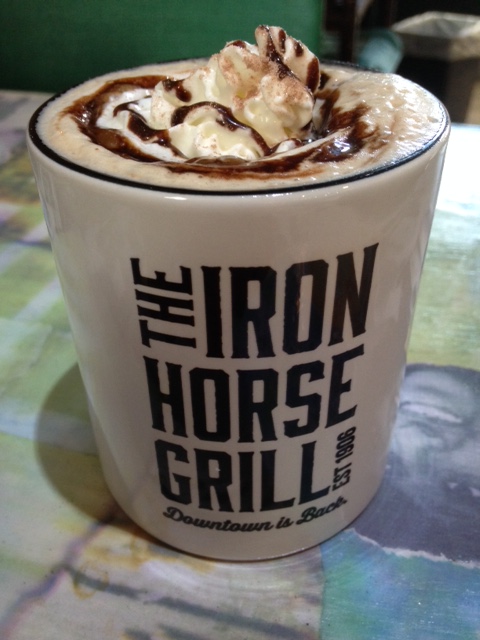
Coffee by Jennifer Pendleton at Bricks, French Camp, MS

I would love to sit down with you as you read this. I would love to visit over a leisurely cup of coffee and hear about the parts of your life that have no script. The parts that leave you feeling helpless and hopeless. The parts that make you say, “What am I supposed to do now?”

I would tell you about the situations in my life where I’ve slammed into brick walls, hurt, confused and wishing I had a script to follow, a map out of the darkness, a way to stop the pain.

As the steam rises from our coffee cups, we can remind each other that the brokenness of this world will knock on our front door, no matter how much protection we think we have wrapped around our life. There’s no bubble wrap for life.

And that is where the fight for hope begins. Because when there is no script, we get to write our own lines. We become Hope Warriors. And we just may find the badass hiding inside us as well.

When There Is No Script has been about finding our footing in the darkness, asking questions about the journey, and meeting brave Hope Warriors along the way.  We’ve looked at questions like:

Why fight for hope?

What is hope?

What does fighting for hope look like?

What is a hope warrior?

What is brokenness?

Sprinkled among these posts, I’ve had the honor of sharing stories of Hope Warriors – people who have decided that the struggle will not define them, and the darkness will not win.

Heather Hollander wrote about the reality of having hope when the world is filled with suffering and tragedy in her post Do The Next Thing.

Tara Dickson shared about her fight for hope in the midst of losing her husband to brain cancer in Beauty in Sorrow.

Becky Spies shared how God beautifully redeemed the broken and hurting places in her life.

Linsey Ewing wrote a courageous post about  becoming a Hope Warrior and her journey with Bipolar Disorder.

Tammy Gonzalez shared a piece of her story that reminds us of the power of words – the negative ones we speak to ourselves and the life-giving ones we receive from others.

Natalie Ogbourne wrote about her fight for hope in the midst of discouragement and despair in Standing Against the Waves.

These stories are so important. It took great courage for these ladies to write about their fight for hope and it gives courage to us, the readers of their stories. Because even if our struggles don’t look the same, our needs are the same. We need to know that we will see the beauty of redemption and that the fight will have been worth it.

The darkness doesn’t last, but the strength that comes from fighting does.

Keep fighting for hope, my friend.

You are worth it.

Sparks of Hope

Each of us fight battles as we live, day-by-day, in this broken world. If we keep our eyes on the battle we are sure to grow weary. When we recognize the sparks of hope around us, we find rest in the midst of our battle.

Sparks of hope are vital in the fight for hope because they awaken a quiet, fierce strength inside of us.

Sparks of hope remind us that we are warriors. Hope Warriors.

Hope warriors

Sparks of hope stir our courage and remind us that hope is worth fighting for. Feeling courage reminds us that we are not meant to live life numb.

Sparks of hope are a reminder in the midst of our battle that there is a bigger story. And that our part of the bigger story is worth telling.

Sparks of hope sharpen our focus and our determination that the free fall will not define us and the darkness will not win.

The sparks of hope that give me courage usually involve words, beauty, and music.

A beautiful sunset reminds me of God’s faithfulness and His promise to never leave me.

IMG_5775

A Bible verse on the drive through window of a coffee shop reminds my heart to hang on to hope.

024

A line in a movie may speak to me in a way the screenwriter never could have known.

The lyrics and music of a song reminds me that I am not alone. (This song also makes me dance.)

Sparks of hope remind us who we are and what we are fighting for.

What sparks of hope have you seen lately? I’d love to hear about it.

What Is Brokenness?

img_8973

As I’ve put thoughts to paper and shoes on the idea of fighting for hope, I’ve described Hope Warriors in this way:

“Hope warriors are people who know their own brokenness, who aren’t afraid of the brokenness they see in others. They are people who say ‘I am with you. You are not alone.’”

What in the world is brokenness and what does it have to do with being a warrior? Warriors are brave and fierce and broken things should be fixed.

Right?

When things are broken, yes. Bring on the duct tape and the superglue. But when people are broken, it is a different matter altogether.

Brokenness is messy and scary…. and beautiful. It takes courage and ferocity and tenacity to deal with our own brokenness. Brokenness is something I couldn’t describe until I saw it lived out in the lives of Hope Warriors around me. And I wanted what they had.

To me, brokenness is seeing ourselves for who we truly are and accepting our story for what it is. It is looking at all the things, the ingredients, that make up our life – things that happened to us, things that we did to others, all the success, failures, and regrets. It is looking at ourselves honestly.

And that takes courage.

To know our own brokenness means that we stop running from ourselves and our story. It means that we look ourselves in the eye and see us for who and what we really are. None of us are as put together or confident as we would like people to think. On the flip side, we are also not as worthless as we’ve made ourselves believe.

Brokenness is bringing these two misconceptions into the light so that we can see ourselves for who we truly are, we can see our story for what it truly is, and begin to live. Once we stop running from our story, we can begin to write the next chapters of our story with purpose.

We don’t face our brokenness alone. Our brokenness is one reason God came to be with us in this world. Jesus was sent to “bind up the brokenhearted.” (Isaiah 61:1) He left the perfection of heaven to be near to us in our brokenness (Psalm 34:18), and to heal us (Psalm 147:3)

The Hebrew word for broken in these verses shabar, which means to break, crush, destroy.

So we could read it like this:

The Lord is near to those whose heart has been broken.

He was sent to heal those who hearts have been crushed.

He heals those whose hearts have been destroyed.

The word shabar also has the meaning “to bring to the birth.” I love this meaning because   when our hearts are crushed, it gives room for the birth of something new. The birth of realizing our need for Christ, the birth of clear sight, the birth of a new direction for our life.

So, the crushing gives way to something beautiful.

The crushing itself is not pretty, or graceful or easy. But we don’t have to fear it. We can see it for what it is, and then let it give birth to something new in our lives. Because sometimes the hardest, most ugliest things end up being fertilizer for the most beautiful.

And as we grow more comfortable with our own brokenness, we can be gentle with the brokenness in others, and reach out to them saying “You are not alone in this.”

Brokenness is messy and scary, beautiful and brave…just like you.

Beauty in Sorrow


IMG_5407-1

It’s the end of September as I write this, and fall is finally making its way to Mississippi. The past few days we’ve been able to walk outside without feeling like we’ve stepped into an oven. The cool breeze feels like refreshing grace after months of intense heat.

Today is the perfect day to sit on the front porch and visit.

I’ve invited Tara Dickson to visit us today and share a bit about her fight for hope. She’s walked down a path of sorrow in losing her husband to brain cancer earlier this year. And yet in her post today, she speaks of finding beauty in the midst of sorrow.

You can connect with Tara on her blog, Bruised But Not Broken, at taradickson.com

Click here to read Tara’s beautiful words.


Broken Places

IMG_3811
Picture by Angela Ewing

When we are sitting in the darkness with our unanswered prayers, our unfulfilled dreams, and the ache of empty places in our heart it is easy to lose hope. It is easy to believe that things will never change.  It is easy to believe that God doesn’t see, doesn’t hear, and doesn’t even care.

The truth is God does see. He does hear our prayers. He does care.

He gathers our tears in His bottle (Psalm 56:8), He is for us (Psalm 56:9), and He works in the broken places to answer the deepest cries of our heart.

I’m so excited to have Becky Spies as my guest today. Becky shares how God beautifully redeemed the broken and hurting places in her life in her post That Time I Got A Letter From God.

You can connect with Becky at her blog girl, redeemed at beckypricespies.com

Becoming a Hope Warrior

I am so excited to welcome Linsey Ewing today. Linsey is my cousin (which makes her FABULOUS in my book) and, even more important, she has a story of hope that she is just beginning to share.  Linsey’s courageous post gives an inside view of her fight for hope in the midst of being diagnosed with Bipolar Disorder.

*******************************************

“Hope warriors are people who know their own brokenness, who aren’t afraid of the brokenness they see in others. They are people who say ‘I am with you. You are not alone.’”

When I saw these words on Erin’s blog, I gave a mental cheer.

I’m a Hope Warrior!
ompaz-dn-9i-greg-rakozy

I believe hope is an essentially human quality—what separates us from every other creation in the universe. For a time, though, I forgot this little maxim of mine, and I gave up hope, or I thought I did. I stopped listening to myself and I failed to recognize the great power I had within me—the power that hope gives us.

Now I know I’m a Hope Warrior and I do my best to use that power every day. I’d like to share my story with you, my struggle for hope and how that hope was, for a time, a bent and twisted thing, and the freedom that I’ve found in real hope.

I’ve struggled with depression all my life. Even as a young child I withdrew from people, partly because I am intensely introverted, partly because I would occasionally receive an emotional blow from some heavy, age-inappropriate topic and needed to retreat to process it.

My depression became more pronounced through my adolescence and young adulthood, when hormones and general angst didn’t do me any favors, and I fought it through every means available.  I went to therapy, took prescription medication, and self-medicated with a lot of alcohol and a little drug use.  Several of those things worked, while I was using them, but none of them treated the underlying problem, mostly because I never realized there was an underlying problem.

Though I got several “diagnoses,” no one explained to me that I had a disease that would require constant attention and treatment. As a result, I would go to therapy or take anti-depressants for a few months, feel better, and stop treatment until it got so bad that I needed help again. And I only got help when it was really bad—when I stopped functioning, couldn’t stop crying, couldn’t get out of bed for a week, or had self-harm fantasies.

The worst of these times was March 2012. In the first months of that year, my life flipped upside down, and I was under extreme pressure.  I completely broke down, as I believe anyone would have under the circumstances. I was encouraged seek help, which I did, and I was put on yet another anti-depressant. This time I stayed on it.

Six months later I met some friends at a local bar for drinks. When they were ready to go, I told them I was going to finish my beer and I’d be right behind them, but I didn’t leave after that beer. I stayed another five hours. I drank more beer. I drank a total of eight 16oz cans of beer. I closed the place down, talked to everyone there, almost went home with someone to whom I’d given a fake name, and all but danced on the bar.

At closing, I got in my car and drove home. I passed two police cars, one of which had someone pulled over, but no alarm bells went off. I missed my driveway and had to back up and try again. I walked in the door and fell in my bed fully clothed including shoes.

When I woke up, I couldn’t believe what I had done—literally couldn’t believe I had acted that way. (Remember how I said I was an intense introvert?)  I hate talking to strangers. I don’t like bars and will only go if I’m with a friend or a small group and don’t have a choice. I’m not a drinker since my early college (self-medicating) days. I am a rule-follower—it’s not like me to drive drunk or be heedless of authority figures around me.

This behavior was so far outside my character it was like I’d been possessed. I was so ashamed of myself that I spent that Sunday wallowing in self-hatred. First thing Monday I began making calls, trying to find a doctor to help me figure out what happened.

Many months and mental health professionals later, I was diagnosed with Bipolar Disorder, untreated and undiagnosed because I had only ever presented with symptoms of depression and this was my first manic episode. It did, however, mirror an earlier period when I was drinking heavily (self-medicating with a depressant) and acting out wildly, but at that time neither I nor anyone around me was aware I was acting out of character. Basically the depressants (prescription or otherwise) only treated half of my disease, causing the other half to manifest disproportionately.

Bipolar also explained other behaviors that I now know are hypomanic (still potentially harmful, but not as obviously reckless as behaviors typically associated with mania), but that I had always assumed were character flaws or strengths: bouts of frenzied spending; inability to manage my money;  times when I would start a dozen projects without completing any of them; times when I would take on more than any reasonable person could expect to accomplish—and pull it off; losing time; and soaring feats of creativity and accomplishment.

Those words, “Bipolar Disorder” were like a death toll for me. Those words meant I was crazy and I would never be normal. They meant I would have to keep this filthy secret about myself, because I would be judged from the moment anyone knew and no one would ever love me. I knew I’d never be able to have another romanic relationship, because who would want to be with someone crazy? I knew I’d never be able to have children because I wouldn’t be able to take care of them, plus I could pass this disease along.

I no longer knew what parts of me were me and which parts were the disease. I suddenly didn’t know who I was anymore.

In my mind, depression was an ok thing to have (remember I’d never thought of it as a disease), but Bipolar Disorder was a disorder, something that I’d have to live with forever, from which I could never be cured or healed, for which there was no hope.

Speaking of hope, isn’t that supposed to be what I’m talking about?

Yes, but Erin’s quote is also about brokenness—recognizing it in ourselves and others and being unafraid of it. I’ve never been afraid of others’ brokenness, but I was terrified of my own. I thought it was my fault for being sick—not that Bipolar Disorder explained why I did sometimes did “bad” things, but rather it was the reason I was a bad person.

I lived with this mentality for four years, and I got so used to living with it that I stopped noticing how it affected my outlook and attitude.  In those years I had more big life-changes, and in 2014 things really started to go downhill fast. I stayed depressed—my medication kept me out of bed most of the time, but I lived in daily fog of unhappiness. When I paid attention to it at all, I blamed the depression on my external circumstances—my living situation, my home, my job. I never acknowledged that things were steadily getting worse, regardless of what was happening in my environment.

Then my amazing therapist recommended (actually, she more or less twisted my arm off) I enter a outpatient day program to see if we could get to the source of the problem. What finally convinced me to try it was when she looked me in the eye and said “We are missing something. Your quality of life is shit.” I realized she was right, and I hadn’t noticed.

Some other things I hadn’t noticed until I was in the program was how little I was doing to help myself—how little hope I had, and how twisted and wonky that hope was.

I never hoped to get better. I never hoped to be understood, accepted, treated fairly, or acknowledged as a human being rather than a disease. I never hoped to be loved for my true self. I never hoped to be successful or to do meaningful work. I never hoped to get married or have children.

Here are the things I did hope for: I hoped it would go away. I hoped swallowing pills would remove my symptoms—I was right to take my medications, but I never paid attention to what they were (not) doing for me, so I failed to participate in my own treatment. I hoped that other people would read my mind, that they would research my disease and find ways to help me with it, but I was unwilling to communicate about or research it myself. I hoped that people would love me in spite of my disease and for myself alone, but I withheld myself from them. I hoped that I would not get depressed or manic, but did nothing to prevent it. I hoped people would reach out to me, but I withdrew from them and sometimes even punished them for asking questions. I hoped that therapists and doctors would cure me, but I did little to help them understand what was wrong.

But this story has a happy ending. Now that I’ve completed treatment and embraced my Hope Warrior status, I’m happy to say that I’m healthier than I have ever been, and my hope is fat and healthy. I can contemplate my own brokenness without fear, or even sadness.

I have accepted that I have an incurable disease, that it is part of me but doesn’t define me, and I believe I am great because of and in spite of it.

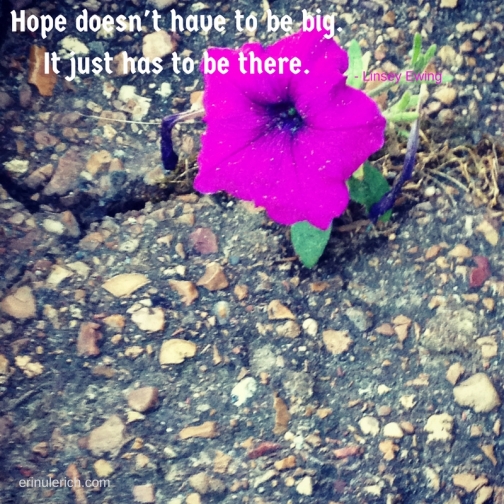
The best news is I have TONS of hope. Here’s the thing though—the hope I have these days isn’t always big or grand—I can’t always manage to hope for world peace—but it’s real and realistic, and that’s the cool thing about hope. It doesn’t have to be big, it just has to be there.
hope-doesnt-have-to-be-big-it-just-has-to-be-there

Here’s what I hope now: I hope my story helps you, whether or not you are mentally ill. I hope for some of you I put words to things you didn’t even know were in your heart, as Erin’s words did for me. I hope you see that the following list can apply to any situation that seems hopeless, not just facing Bipolar or another disease:

Oftentimes hope for me means getting out of bed in the morning, not going to bed in the afternoon, or setting a 30-minute timer for being in bed. Sometimes hope means hanging on when I know things will not look better in the morning or for many mornings after—when I know tomorrow will be just as bad if not worse than today.  It means having faith that, when I’m doing things that hurt me, I will eventually stop—that at some point I will come back to baseline (or “normal”) and I will be able to sort out whatever mess I’ve gotten myself into.

Hope is forgiving myself for making those messes and planning for future messes. Hope is strategizing ways to keep myself safe when I’m not myself. It’s asking for help from those who love me and trusting that they do love me, even when I feel most unlovable.  It means being open and honest about what I’m going through, with myself as well as with others. Hope means knowing I have a disease that is at best manageable, not curable, that it does and will affect me every day of my life, but that does not mean every day has to be affected by it.

The hardest part of being a Hope Warrior is knowing that my friends and family do not understand, not because they don’t love me, but because they are not me. They don’t understand because they are ignorant, and that is not their fault. They don’t feel and see and know what I do. If I want them to, I have to tell them, but my powers of description are limited, and I need to realize that they will never completely understand. My parents will continue to ask questions that hurt me. My friends will continue to invite me to do things that would be harmful to me. They can’t remember everything, and they are not responsible for my care.

Hope is remembering, when those things happen, that it does not mean I am unimportant or unloved. Hope is caring for myself instead of waiting for others to do it for me. Hope is choosing to see love as it is given to me, not only how I would prefer to receive it.

Hope is hard.

That’s why it takes a Warrior.